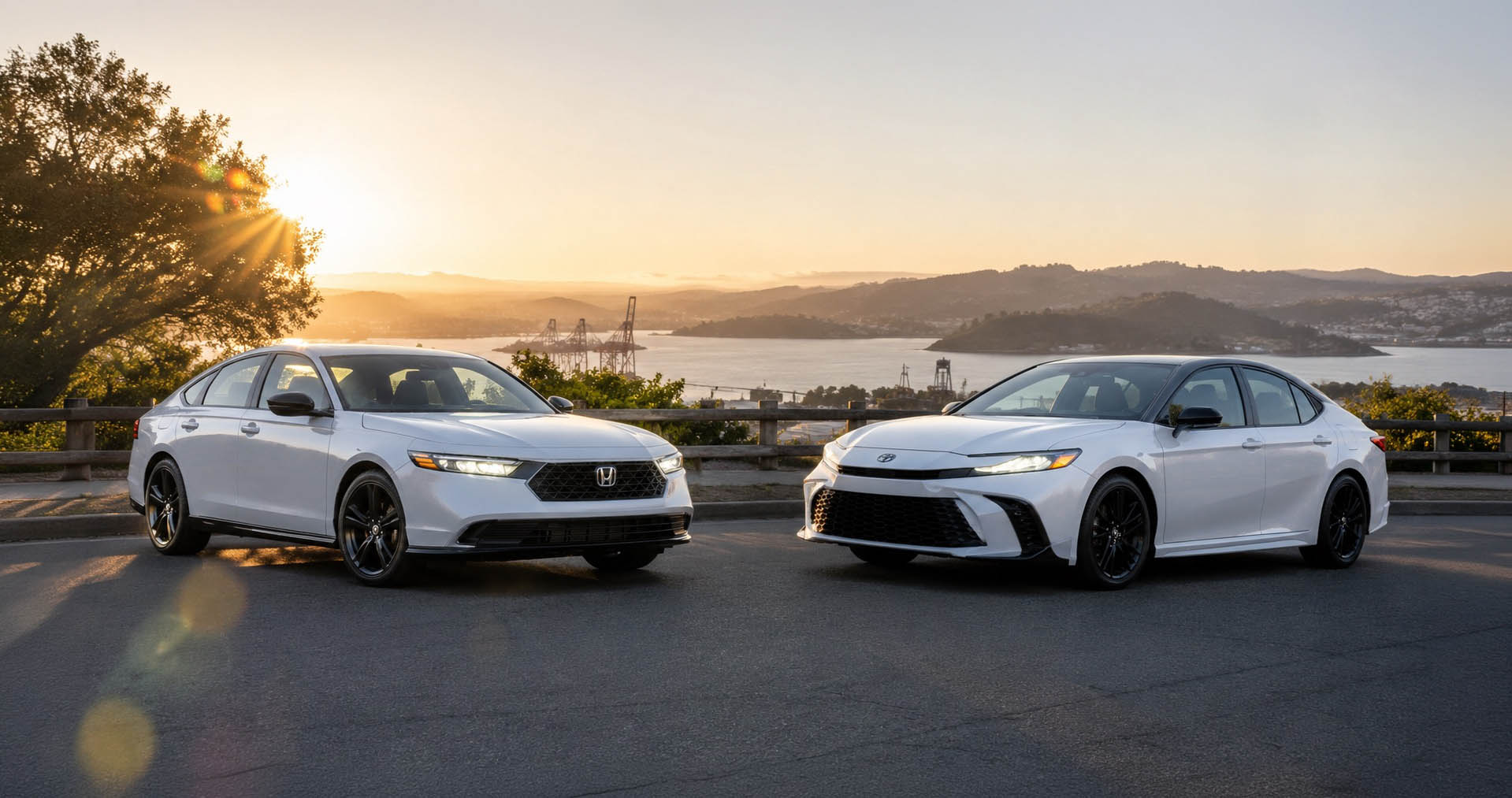
Hybrid Sedan Comparison
2026 Honda Accord Hybrid vs Toyota Camry Hybrid
More Everyday Space & Standard Tech, or Lower Hybrid Entry Pricing & Available AWD?
The 2026 Honda Accord Hybrid and 2026 Toyota Camry are unusually close in purpose. Both are five-passenger midsize sedans built around hybrid efficiency, comfortable daily driving and modern driver-assistance technology. The Camry is hybrid-only for 2026, while Accord reserves its two-motor hybrid system for the four upper trims.
The comparison works because the two sedans aim at nearly the same kind of driver even though they do not package the mission identically. Both make hybrid efficiency easy to live with in a conventional midsize sedan, both have the space and technology to serve as a primary household car, and both are polished enough for longer Highway 4 or broader Bay Area mileage. Because their strengths overlap so much, the meaningful separation comes from a few packaging, drivetrain and equipment choices rather than from one car simply doing everything better.
That makes this comparison especially relevant around Pittsburg and the Highway 4 corridor, where stop-and-go traffic, longer regional mileage and practical passenger use can all matter in the same week. Use the sections below to identify which difference would actually repeat in your routine, then compare the exact trims and configurations you would realistically buy.
Which Hybrid Sedan Fits the Way You Actually Use It?
Choose the priority that most strongly shapes your decision. The result is a starting direction, not a verdict; the comparison panels below test it against efficiency, drivetrain, passenger space, trunk room, technology, safety and ownership costs.
Based on This Priority
Passenger & Trunk Space Matter Most
Start With the Accord Hybrid
Who This Favors
Drivers who regularly carry adults or child seats in back and want the larger published trunk without moving to an SUV.
Why It Points Here
Accord Hybrid provides 40.8 inches of rear legroom and 16.7 cubic feet of trunk space, versus 38.0 inches and 15.1 cubic feet for Camry.
Accord Hybrid vs Camry Hybrid in 60 SecondsFive differences most likely to shape your shortlist
Which is more fuel-efficient?
Camry at the top of the EPA range. Camry LE FWD is rated at 52 city / 49 highway / 51 combined MPG, while Accord EX-L Hybrid reaches 51 / 44 / 48 MPG.
Which gives rear passengers more room?
Accord, by 2.8 inches on the published rear-legroom figures: 40.8 inches versus 38.0 inches.
Which has the bigger trunk?
Accord, at 16.7 cubic feet versus 15.1 cubic feet for Camry.
Which offers AWD?
Camry. Every Camry trim can be configured with Electronic On-Demand AWD; Accord Hybrid is front-wheel drive only.
Which starts lower?
Camry. At the hybrid entry point, LE FWD starts at $29,600 before destination versus $33,795 for Accord Sport Hybrid—a $4,195 gap. That is a base-price comparison, not an equipment-matched one; the difference can narrow substantially when you compare other trims.
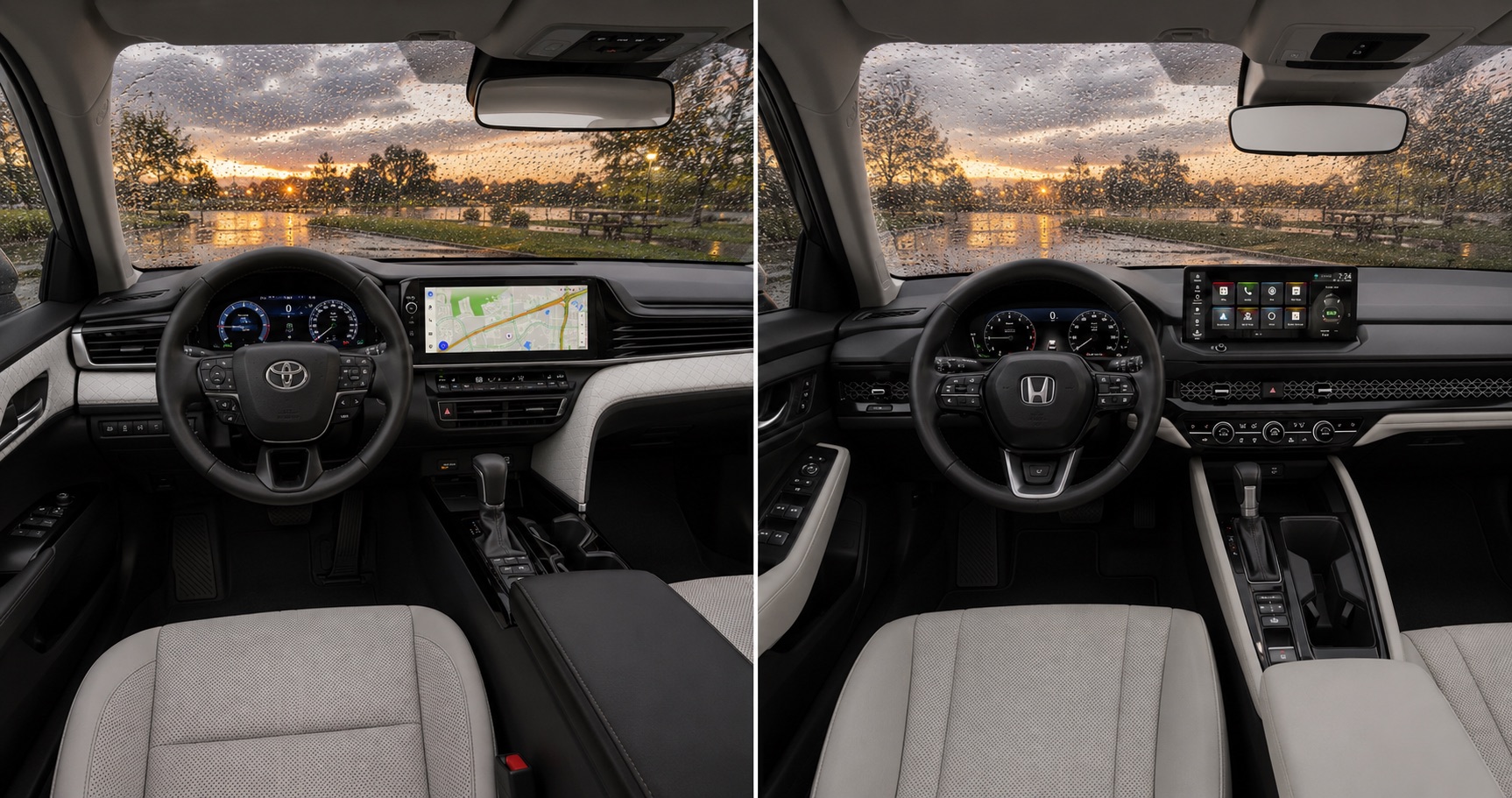
Compare the Trade-Offs That Separate Accord Hybrid & Camry Hybrid
These sedans overlap heavily on hybrid commuting, comfort and safety. Use the topics below to separate the handful of differences that can change daily ownership: MPG, drivetrain, rear-seat room, trunk capacity, interface hardware, price and included maintenance.
Independent Review Thoughts
Car and Driver Ranks Accord First & Camry Second
+ Names Both Editors’ Choice
Car and Driver
2026 Honda Accord
Editors' Choice • 2026 10Best
Excellent ride-and-handling balance. Stretch-out passenger space. Strong hybrid efficiency and intuitive controls.
Car and Driver’s 2026 review makes the Accord’s appeal broader than one specification. It points to passenger space, composed road manners, practical interior design and the hybrid powertrain as a particularly strong combination—useful context for shoppers who want efficiency without giving up midsize-sedan room.
Car and Driver
2026 Toyota Camry
Editors' Choice
Smooth hybrid powertrain. Comfortable, roomy cabin.
Strong fuel economy and available AWD.
Car and Driver treats Camry as a complete family sedan rather than an efficiency special. Its review emphasizes the smooth hybrid system, comfortable interior and fuel economy, while the available AWD configuration adds a mechanical choice Accord Hybrid does not provide.
See How the Accord Hybrid Fits Your Daily Drive
Bring the passengers or gear that make space matter, then check rear-seat comfort, trunk shape, visibility, screen layout, brake feel and hybrid response. If Camry’s lower price, higher MPG or AWD remains the priority, keep those differences as the benchmark while you evaluate the Accord Hybrid trim that fits your budget.
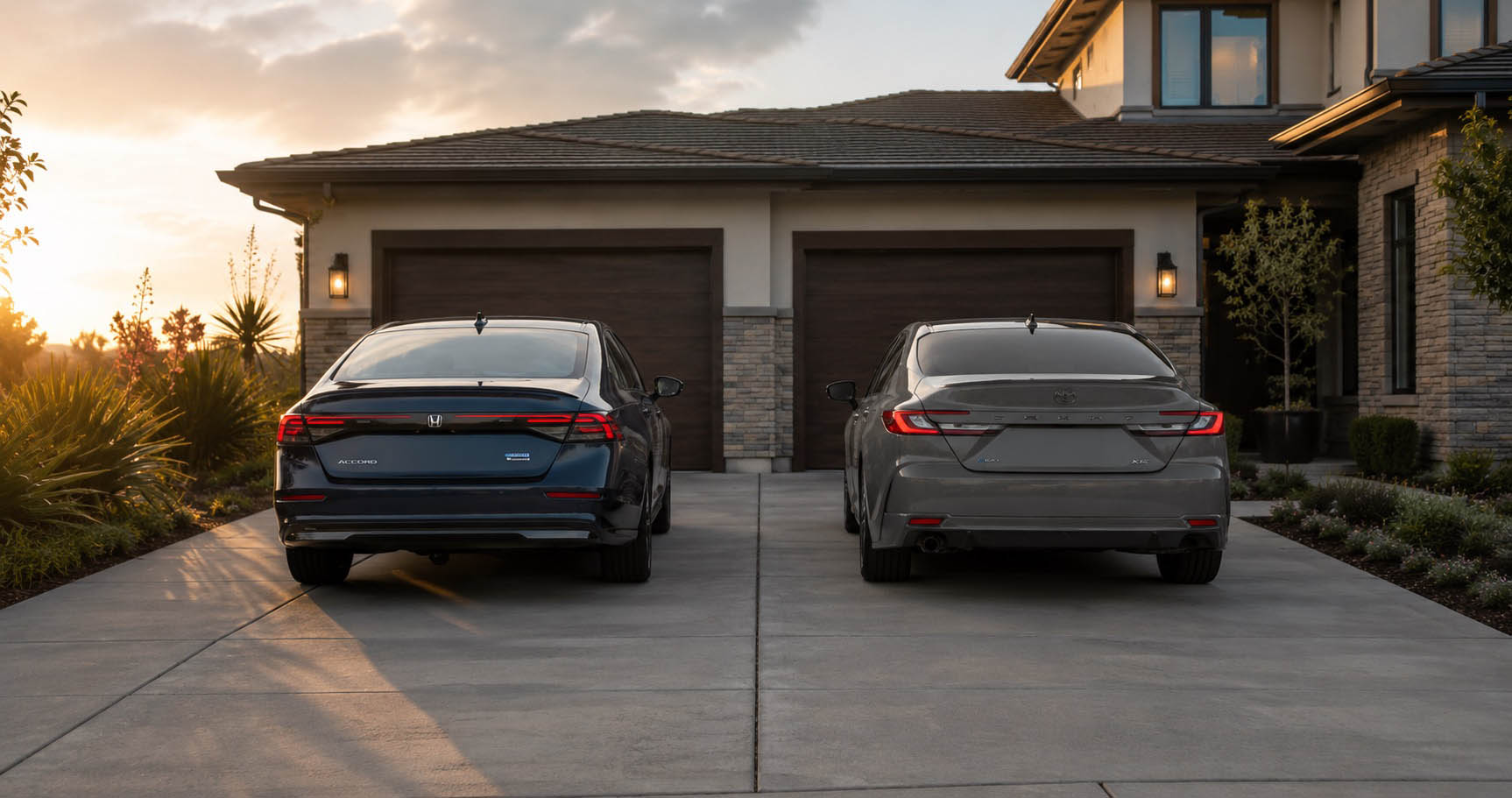
How the Accord-Camry Trade-Offs Add Up
Which Difference Would You Notice After the First Month?
The cleanest way to separate these sedans is to distinguish the hard-to-work-around differences from the smaller ones. Camry has the stronger case when the lowest hybrid entry price or AWD availability is central to the purchase, and it also holds the higher peak EPA rating. Accord answers with advantages that can show up repeatedly in everyday use: more published rear-seat and trunk room, larger display hardware standard across every hybrid trim and, according to Car and Driver, the stronger overall 2026 midsize-sedan standing. For shoppers who do not need AWD and are not buying strictly on the lowest entry price, that broader mix gives Accord the stronger all-around starting point.
That does not make Camry an afterthought. Once you move away from the base trims, some midrange prices sit only a few hundred dollars apart, independent acceleration results are essentially even despite Camry’s higher rated output, and upper Camry trims close several technology gaps. At that point, seat comfort, controls, ride quality, noise, styling and the exact equipment on the two trims under consideration should finish the decision.
Still split between the two?
Use the Best-Fit Quiz below to identify your stronger starting point.
2026 Honda Accord Hybrid vs Toyota Camry Hybrid FAQs
Delta Honda
Make Accord Shopping & Ownership Simpler With the Delta Difference
Delta Honda is part of Harvey Auto Group, and the dealership’s Delta Difference is built around clearer information, transparent pricing and customer-first support across sales, finance, service and parts. For shoppers arriving with research already in hand, that means the dealership conversation can stay focused on the exact Accord configuration, purchase terms and ownership questions that still need to be resolved.
Current Accord inventory, online trade valuation, financing tools and Honda offers let shoppers build more of the transaction picture before arriving. That can reduce back-and-forth at the dealership, make the budget easier to understand up front and leave the visit focused on the vehicle and the remaining questions rather than restarting the purchase process from scratch.
After purchase, Delta Honda keeps routine ownership support at the same Pittsburg location with Honda service, Genuine Honda Parts and Honda Express Service for qualifying walk-in maintenance such as oil changes, tire rotations, filters and inspections. Factory-trained Honda care and a no-appointment Express option can be especially useful for drivers fitting maintenance around work, school schedules and East Contra Costa commuting.
Where to Go Next
Choose Your Next Research or Shopping Step
Start Shopping
Put the Accord Hybrid Decision Into Motion
Research Next
Keep Comparing the Options That Fit Your Priorities
Disclaimers:
*Vehicle specifications, equipment, trim availability, incentives, inventory and prices may be revised. Verify the exact vehicle before making a purchase decision.
*2026 Honda Accord Hybrid and 2026 Toyota Camry Hybrid MSRPs shown exclude destination/delivery, tax, title, registration, dealer fees, accessories and optional equipment. Manufacturer pricing and dealer pricing can change the relevant transaction price.
*Fuel-economy figures are EPA estimates for comparison and vary by trim, wheels and drivetrain. Actual mileage varies with equipment, weather, loading, maintenance, traffic and driving style.
*Horsepower figures are manufacturer-rated combined system output. Car and Driver acceleration results are instrumented test results from the specific vehicles tested; trims, tires, equipment and test conditions differ, so those results are comparative context rather than a performance guarantee.
*Interior and cargo dimensions are manufacturer-published figures, and cross-brand measurement methods are not necessarily identical. Verify passenger comfort, trunk opening and actual cargo fit with the people and items you normally carry.
*Honda Sensing, Toyota Safety Sense 3.0, blind-spot systems, AWD and other driver-assistance or traction technologies have operating limitations and do not replace attentive driving, appropriate tires or sound judgment for road conditions.
*Warranty, included-maintenance, roadside-assistance and hybrid-battery coverage are subject to manufacturer terms, exclusions and time/mileage limits. Honda states 10-year/150,000-mile high-voltage battery coverage in California; Toyota states 10-year/150,000-mile hybrid-battery coverage.
*Car and Driver ratings, rankings, awards, review conclusions and instrumented test results shown here were checked September 3, 2026 and may be updated later.
*Delta Honda inventory, pricing, offers, finance tools, trade tools and service availability can change. Eligibility, program terms and coverage conditions apply; ask Delta Honda to confirm the current details that apply when you shop or schedule service.